Bruise
Introduction
A bruise (also known as contusion) is an injury appearing as an area of discoloured skin that is commonly caused by blunt impact, such as a fall, trauma or bump, resulting in damage of the soft tissues, including rupture of small blood vessels (capillaries) without cuts on the skin.
- Older people are more prone to bruising.
NOTE: A haematoma is a larger collection of blood, usually caused by surgery, injury or greater trauma. Like a bruise, haematomas will usually be reabsorbed into the body. However, depending on the size, location and cause of the haematoma, the area may need to be drained surgically or take a longer period of time to resolve.
Symptoms
The blunt force trauma damages capillaries beneath the skin, causing blood to leak into the surrounding tissue.
- Skin discolouration is initially red or pink, gradually becoming blue, green and yellow.
- Most bruises heal in 1 to 2 weeks, but some take longer.
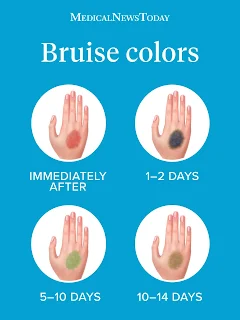
NOTE: The characteristic colour changes of a bruise are due to the breakdown of haemoglobin. Haemoglobin is initially red in oxygenated blood, becomes dark bluish-purple when deoxygenated, and is then broken down into other pigments such as biliverdin (green) and bilirubin (yellow) as the bruise heals.
Referral to Doctor
Frequent or unexplained bruises, as it may indicate an underlying condition, such as
- Bleeding disorder (e.g. haemophilia, von Willebrand disease)
- Thrombocytopenia
- Cancer
Very painful swelling in the bruised area.
Bruise does not disappear after 2 weeks.
Management
Most bruises are not a cause of concern and may heal on their own in 2 weeks as the blood is absorbed by the surrounding tissues and carried away.
Practice RICE
- Rest the affected area if possible.
- Apply ice pack wrapped in towel for 10-20 minutes, several times a day, for 1-2 days.
- Compress the affected area if there is swelling using an elastic bandage.
- Elevate the affected area.
Treatment options
- Paracetamol and NSAIDs to help relieve pain associated with bruising.
- Proteolytic enzymes (e.g. chymotrypsin and serratiopeptidase) may help in relieving bruise, swelling and pain due to trauma.
- Use with caution in patients with coagulation disorders.
- Aescin, the main active compound in horse chestnut seed, has been evaluated for use in bruising.
Summary
During the first 48 hours after an injury, avoid using heat packs or heating pads.
- At this stage, heat can worsen bleeding and swelling due to its vasodilatory effect, which increases blood flow to the injured area.
- However, after 48 hours (i.e. once active bleeding has ceased and swelling has subsided), warm compresses may be applied to promote blood reabsorption and enhance circulation.
Comments
Post a Comment