Vertigo
Introduction
Vertigo is an illusion of rotational, liner or tilting movement of self or environment. It could be produced by peripheral (inner ear) or central (brainstem-cerebellum) stimulation.
- The most common motion illusion is a spinning sensation.
- Nausea and vomiting are typical with acute vertigo, unless it is mild or very brief, as with benign paroxysmal positional vertigo (BPPV). Vomiting can be severe, causing dehydration and electrolyte imbalance.
- Postural stability can be affected in patients with vertigo.
NOTE: It is important to distinguish vertigo from other potential causes of "dizziness".
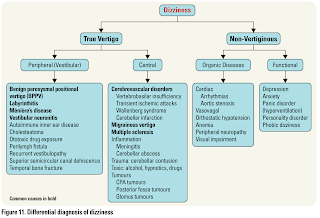
Evaluation
The clinical features of the most common disorders are summarized in the table below.
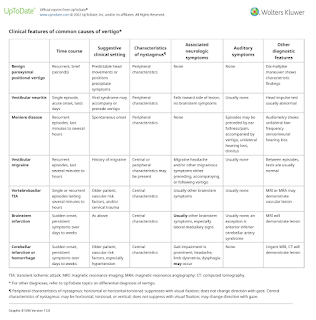
NOTE: The time course of symptoms provides one the best clues to the underlying pathophysiology of vertigo.
Symptomatic Treatment
Medications to suppress vestibular symptoms are best used for alleviating acute episodes of vertigo that last at least a few hours or days. These drugs are not useful for very brief episodes of vertigo, such as benign paroxysmal positional vertigo, except when the frequency of spells is very high.
- Antihistamines
- e.g. meclizine, dimenhydrinate, diphenhydramine
- Drugs of choice in most patients.
- Meclizine is the drug of choice in pregnancy.
- Histamine analogue
- Betahistine is an analogue of histamine and is claimed to reduce endolymphatic pressure by improving the microcirculation. It is licensed for vertigo, tinnitus and hearing loss associated with Ménière's disease (including long term control and can be given with or without diuretics).
- Betahistine dosing range: 24 to 48 mg daily in divided doses. Doses slowly titrated up to 480 mg daily have been reported in a small number of cases with severe, resistant disease.
- Benzodiazepines
- e.g. diazepam, lorazepam, clonazepam, alprazolam.
- Can be sedating and are used when antihistamines are not adequately effective.
- Antiemetics
- e.g. ondansetron, prochlorperazine, promethazine, metoclopramide, domperidone.
- Also helpful for nausea and vomiting associated with acute vertigo.
- Phenothiazine antiemetics (e.g. prochlorperazine, promethazine) are more sedating and associated with extrapyramidal symptoms.
Symptomatic treatments should be stopped as soon as possible after severe symptoms and vomiting cease (usually within 1 or 2 days) to avoid compromising long-term adaptation to vestibular loss by the brain.
Supplements
Beyond its evaluation for enhancing cognitive function and its protective role in cardiovascular health, Ginkgo biloba extract is widely utilized as a natural remedy for vertigo and dizziness.
Despite its purported effectiveness, published reviews, meta-analyses and clinical guidelines show equivocal results regarding the use of ginger for nausea and vomiting (e.g., antiretroviral-induced, chemotherapy-induced, postoperative, or pregnancy-related).
Supplementation of vitamins B12 and D should be considered if a deficiency is present.
Comments
Post a Comment